
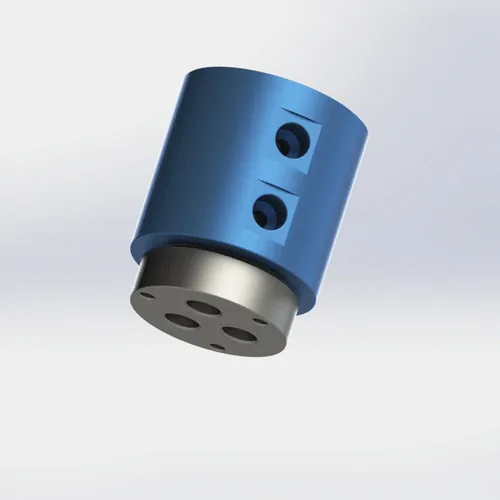
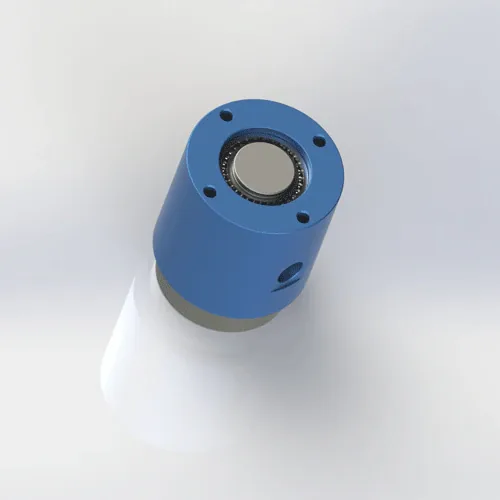
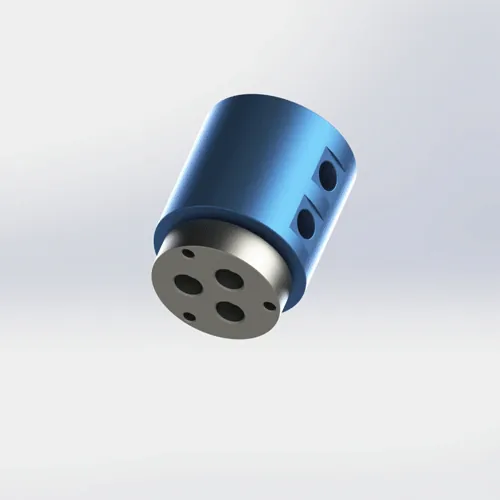
Triple-passage G1/4 threaded rotary joint with 6mm orifice for pneumatic and light fluid applications. PTFE composite seal, AL6061 body. ?64 × 78 mm, 360 g. Ships in 7 days.
BP-3P-0006 is a triple-passage G1/4 threaded rotary joint designed for compact multi-channel pneumatic and light fluid applications. The 6mm orifice provides higher flow capacity than 4mm variants, while the ?64 × 78 mm envelope fits small machine frames. The PTFE composite seal handles air, water, coolant, and light hydraulic oil with one seal compound.
| Model Number | BP-3P-0006 |
|---|---|
| Number of Passages | 3-in-3-out (triple passage) |
| Mount Type | G1/4 Threaded |
| Max Pressure | 1 MPa (10 bar / 145 psi) — derate to 0.7 MPa for continuous water or coolant duty |
| Max Speed | 200 RPM — derate to 150 RPM for continuous water or coolant |
| Body Material | AL6061 Aluminum Alloy |
| Seal Type | PTFE Composite Seal with FKM O-ring backup |
| Compatible Media | Air, Water, Oil, Coolant, Light Hydraulic Oil (ISO VG 32 max) |
| Operating Temperature | -20°C to +80°C |
| Net Weight | Approx. 0.36 kg (360 g) |
| Dimensions | ?64 × 78 mm |
| Certifications | ISO 9001:2015, CE, RoHS |
| Warranty | 12 Months |
AL6061 aluminum body: 6061-T6 aluminum alloy with yield strength 276 MPa and excellent corrosion resistance when anodized. The 0.36 kg mass and ?64 × 78 mm envelope make this one of the most compact 3-passage threaded joints available. Anodizing thickness is 15–25 microns for corrosion protection in water and coolant environments. Not recommended for abrasive coolant or high-impact environments without additional protective coating.
PTFE composite seal: Polytetrafluoroethylene with glass fiber and graphite filler. Self-lubricating, chemically inert, and rated for -200°C to +260°C. The composite structure provides structural integrity while maintaining the low friction coefficient (0.05–0.10 against steel) that makes PTFE ideal for rotary seals. FKM O-ring provides static sealing at the housing interface. One seal compound handles all compatible media, simplifying maintenance.
G1/4 thread advantage: BSP parallel (BSPP) per ISO 228-1 with 1.337 mm pitch. The G1/4 thread matches standard pneumatic fittings worldwide, eliminating adapter costs and leak points. The 6mm orifice provides 2.25× the flow area of a 4mm orifice, reducing pressure drop in vacuum and high-flow applications. For even smaller envelopes, the G1/8 variant BP-3P-0007 offers a 4mm orifice in a ?78.9 × 63.9 mm body.
BP-3P-0006 is designed for compact multi-channel pneumatic applications where G1/4 threaded connections are preferred over flange mounts. The 6mm orifice and 0.36 kg mass make it ideal for mid-size automation equipment. This model may be suitable for the listed applications when its passage count, mounting, medium, pressure, speed, and temperature limits match the machine requirements.
Proper installation extends seal life from 6 months to 12+ months. The most common cause of early failure on threaded joints is overtightening, which distorts the AL6061 housing and compresses the PTFE seal unevenly. Follow these steps for reliable operation.
BP-3P-0006 uses G1/4 BSP parallel (BSPP) threads per ISO 228-1. Confirm your equipment has G1/4 female threads or appropriate adapters. The 4× M6 mounting holes on the body are for anti-rotation brackets, not for torque reaction. Download the 2D drawing for exact thread dimensions, pitch (1.337 mm), and tolerances. NPT and metric thread options are available as custom orders with 10-day lead time.
Use PTFE tape (3–4 wraps) or anaerobic liquid thread sealant on the G1/4 male threads. Hand-tighten plus 1/4 turn maximum. Overtightening distorts the seal housing, compressing the PTFE seal unevenly and creating a leak path within days. Torque spec: 10–15 N·m for G1/4. Use a torque wrench — "finger tight plus a quarter turn" is not precise enough for a 0.36 kg aluminum body. Do not use pipe wrenches.
Use the 4× M6 mounting holes to secure the rotary joint body to a fixed bracket. Torque M6 bolts to 6–8 N·m. Never let the body rotate freely with the shaft — the supply hoses will twist and the seal will experience reverse torque, accelerating wear. The anti-rotation bracket must have >3 mm clearance from rotating parts and should not stress the body with side loads.
Use flexible hoses (not rigid pipe) to connect the stationary side to the air supply. Rigid pipe transfers vibration and thermal expansion directly to the joint, stressing the seal. Install a 40-micron filter upstream to protect the PTFE seal from debris. For water or coolant, add a Y-strainer (60 mesh) to prevent particulate damage. Label each hose to match the corresponding passage number to avoid cross-connection.
Run at low pressure (0.2 MPa) and low speed (50–100 RPM) for 5 minutes without load. This beds the PTFE seal against the shaft surface, creating a micro-smooth contact zone. Check all three seal interfaces for leaks. If dry, gradually increase to operating pressure and speed over 10 minutes. Skipping the run-in is the #2 cause of early seal failure — the seal needs time to conform to the shaft surface finish.
Full dimensions, tolerances, G1/4 thread specs, 6mm orifice details, M6 mounting hole pattern, and seal groove details. 120 KB.
Free 3D files provided after inquiry. Includes exact G1/4 thread geometry, 6mm orifice paths, and M6 mounting hole pattern. Use for CAD fit verification before ordering.
Complete guide: thread matching, torque specs, anti-rotation, filtration, run-in procedure, and maintenance checklist. 650 KB.
AL6061 material traceability, hardness test report, and RoHS compliance certificate. Available upon request with order.
Not sure if BP-3P-0006 is the right model? Use this comparison to decide — and know exactly when to upgrade to a different thread size, flange mount, or higher-pressure joint.
| Your Requirement | BP-3P-0006 Fit | Better Alternative | Why Upgrade |
|---|---|---|---|
| Single air line, handheld tool, weight critical | ❌ Overkill — 0.36 kg, 3 passages | BP-1P-0003 | 0.08 kg aluminum, single passage, lower cost |
| Dual air lines, 1 MPa, general automation | ⚠️ Fewer passages needed | BP-2P-0002 | Same G1/4 thread, 1.5 MPa, dual passage |
| Triple lines, G1/4 thread, compact, 6mm orifice | ✅ Perfect | — | — |
| Triple lines, flange mount preferred | ❌ Wrong mount | BP-3P-0004 | Same 3 passages, flange mount, better vibration resistance |
| Triple lines, G1/8 smaller thread, 4mm orifice | ❌ Wrong size | BP-3P-0007 | G1/8 thread, 4mm orifice, ?78.9 × 63.9 mm for miniature fixtures |
| Pressure >1.0 MPa (e.g., 1.5 MPa hydraulic) | ❌ Over pressure | BP-2P-130-0001 | 5 MPa rated, flange mount, heavy duty |
| 4+ independent passages needed | ❌ Too few passages | BP-8P-0001 | 8 passages with independent seals, flange mount |
The #1 cause of BP-3P-0006 warranty claims is overtightening. A technician uses a pipe wrench and applies 20 N·m on a G1/4 thread rated for 10–15 N·m. The AL6061 housing distorts, compressing the PTFE seal unevenly. Incorrect installation or operation outside the specified limits can cause premature leakage. Failure timing depends on alignment, medium, pressure, speed, temperature, and duty cycle. The technician blames the seal quality and requests a replacement — but the root cause was installation torque. Rule: Use a torque wrench. Hand-tighten plus 1/4 turn maximum. G1/4: 10–15 N·m. Never use pipe wrenches on aluminum bodies.
A machine builder connects BP-3P-0006 to the air supply with rigid steel pipe to "save space." The pipe transfers vibration from the compressor directly to the joint, creating a fatigue cycle on the PTFE seal. Within 6 weeks, the seal develops micro-cracks and leaks. The rigid pipe also prevents the small axial movement needed for thermal expansion. Rule: Always use flexible hoses rated for your pressure. Flexible hose absorbs vibration and allows thermal movement. The 50 mm of flexible hose saves the $45 seal replacement.
A maintenance team installs BP-3P-0006 on an indexing table and immediately runs it at 0.8 MPa and 150 RPM. The PTFE seal has not bedded into the shaft surface — microscopic high spots create leak paths. Within 2 weeks, vacuum drops from -0.07 MPa to -0.04 MPa, and parts fall off the fixture. The team replaces the seal, but the same thing happens again because they skip the run-in every time. Rule: Run at 0.2 MPa and 50–100 RPM for 5 minutes before full operation. This beds the seal and extends life from 6 months to 12+ months.
Other rotary joints commonly purchased with BP-3P-0006 — or the models you upgrade to when your application needs a different thread size, flange mount, or more passages.
The standard BP-3P-0006 uses a full AL6061 aluminum body for light weight and good corrosion resistance. The 0.36 kg mass and ?64 × 78 mm envelope make it one of the most compact 3-passage threaded joints available. For full steel construction (heavier but higher rigidity) or special surface treatments, contact our engineering team. All versions are manufactured under ISO 9001:2015 quality management and carry CE and RoHS certifications. Material certificates with full traceability are available upon request with every order.
Yes — the PTFE composite seal and FKM O-ring are compatible with water, water-soluble coolant, and light hydraulic oil up to ISO VG 32. For continuous water duty, derate pressure to 0.7 MPa and speed to 150 RPM to reduce seal wear. The AL6061 body is anodized for corrosion resistance, making it suitable for intermittent water and coolant exposure. For continuous water immersion or deionized water, specify a nickel-plated or stainless steel (304/316) version. Always use a 40-micron filter for water duty to protect the seal from particulate damage.
BP-3P-0006 uses G1/4 BSP parallel (BSPP) threads per ISO 228-1. BSP parallel threads seal on a gasket or O-ring at the port face, not on the thread itself. This means PTFE tape on the thread is for sealing only; the mechanical connection is made by the flat face compressing against the mating port. Download the 2D PDF drawing for exact thread dimensions, pitch (1.337 mm for G1/4), and tolerances. NPT and metric thread options are available as custom orders with 10-day lead time.
Yes — free 3D STEP and IGES files are provided after you send an inquiry. The file includes the exact G1/4 thread geometry, 6mm orifice paths, 4× M6 mounting hole pattern, and the 0.36 kg AL6061 body envelope. Use the 3D file to verify clearance, port direction, and thread engagement length in your CAD assembly before ordering. 3D files may be provided for qualified projects after the application requirements are reviewed. File availability and response time depend on the model and the project information provided. Custom configurations are modeled on request.
Upgrade when your application exceeds the 1 MPa pressure limit, 200 RPM speed limit, or needs a different mounting style. Common triggers: (1) Your pressure requirement rises above 1.0 MPa — BP-2P-130-0001 handles 5 MPa with flange mount. (2) You need flange mount for better vibration resistance — BP-3P-0004 provides the same 3 passages with flange mounting. (3) You need a smaller G1/8 thread for miniature fixtures — BP-3P-0007 offers 4mm orifice in a ?78.9 × 63.9 mm body. (4) You need 4 or more channels — BP-8P-0001 provides 8 passages. The upgrade cost is typically $15–$90 more, but it prevents seal failure from over-pressure or mounting fatigue.
We design custom rotary joints for any number of passages, pressure, thread type, and mounting style. Free 3D STEP file with every inquiry. Typical custom lead time: 10–14 days.
Request Custom Design →Technical Note: All pressure ratings, speed ratings, and material specifications referenced on this page are based on Begapunk BP-series standard pneumatic rotary joints tested under controlled laboratory conditions. Actual performance depends on operating conditions, media quality, installation practices, and maintenance schedule. For applications outside standard ratings — including high-pressure hydraulic above 1 MPa, continuous water immersion, food-grade, or cleanroom environments — consult Begapunk factory engineering before specification. Last updated: June 11, 2026.